
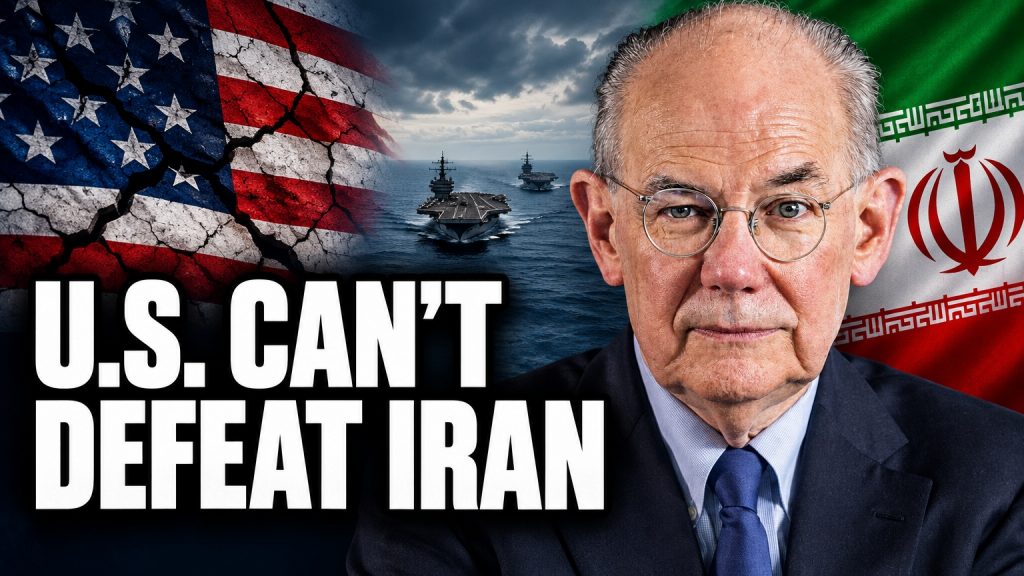
In this video, Professor John Mearsheimer examines the Trump administration’s military and economic strategy toward Iran and its effort to convince Tehran that its position is becoming untenable. He looks at additional U.S. troop deployments, the role of American aircraft carriers, economic pressure on Iran, and whether Washington actually has the means to achieve its objectives.
Mearsheimer also warns about the potential consequences of further escalation for the Gulf region, energy supplies and the global economy. How viable is the American strategy really — and what happens if Iran refuses to give in?
This video was produced by John Mearsheimer and published on their YouTube channel on the 6th of October, 2026. We have translated it into German and are republishing it today to help build opinion on this issue in Germany and beyond.
To read the transcript of the interview: Episode 11: Trump Can’t Bluff Iran into Surrender
We are transitioning away from YouTube. Be sure to subscribe to the following channels to stay updated with our journalism:
About our import program: In this program, we publish content from external authors, activists and journalists. This includes both international and local content that, in our editorial opinion, is not sufficiently covered in the media landscape. The content does not necessarily reflect acTVism Munich’s own editorial stance.
Click here or on the picture below:

John J. Mearsheimer is the R. Wendell Harrison Distinguished Service Professor of Political Science at the University of Chicago, where he has taught since 1982. He graduated from West Point in 1970 and then served five years as an officer in the U.S. Air Force. He then started graduate school in political science at Cornell University in 1975. He received his Ph.D. in 1980. He spent the 1979-1980 academic year as a research fellow at the Brookings Institution, and was a post-doctoral fellow at Harvard University’s Center for International Affairs from 1980 to 1982. During the 1998-1999 academic year, he was the Whitney H. Shepardson Fellow at the Council on Foreign Relations in New York.
Citation of featured image:



Leave a Reply