
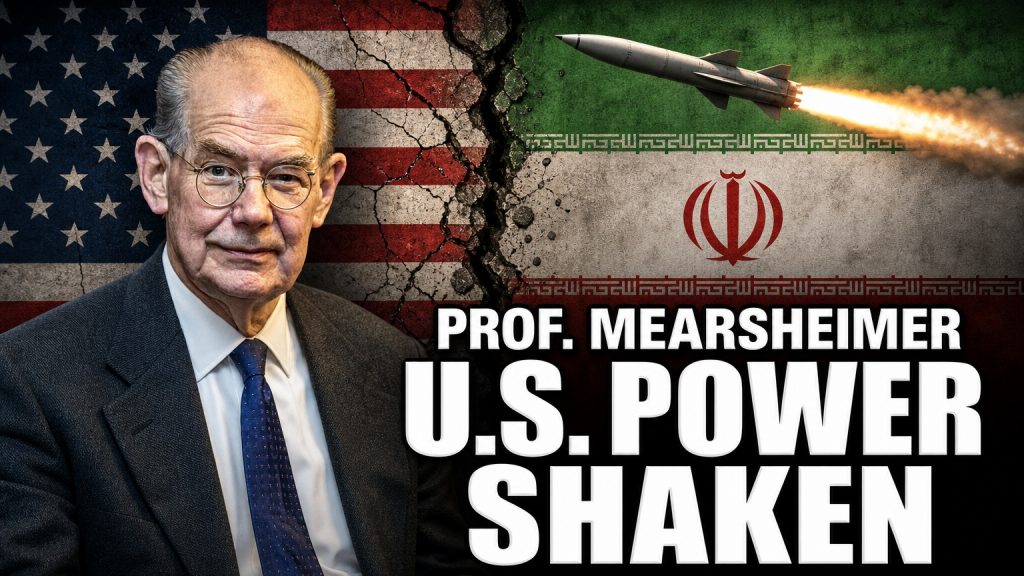
Pulitzer Prize-winning journalist Chris Hedges and Prof. John Mearsheimer examine a war in which, according to Mearsheimer, Washington has no realistic strategy for victory. Their discussion focuses on further attacks against civilian infrastructure, Iran’s growing capacity for retaliation, and the dangers facing U.S. bases, oil routes, and the Gulf states’ vital water supplies.
Mearsheimer draws parallels with Vietnam, Afghanistan, and Iraq: military failure followed by repeated escalation. The conversation reveals how quickly the Iran war could expand into a humanitarian and global economic crisis—while leaving open whether it ends in another “forever war” or a negotiated settlement.
To read the transcript of the interview: Prof. Mearsheimer: Iran’s Missiles Shake U.S. Power
This video was produced by The Chris Hedges Report and published on their YouTube channel on the 19th of July, 2026. We have translated it into German and are republishing it today to help build opinion on this issue in Germany and beyond
We are transitioning away from YouTube. Be sure to subscribe to the following channels to stay updated with our journalism:
About our import program: In this program, we publish content from external authors, activists and journalists. This includes both international and local content that, in our editorial opinion, is not sufficiently covered in the media landscape. The content does not necessarily reflect acTVism Munich’s own editorial stance.
Click here or on the picture below:

John J. Mearsheimer is the R. Wendell Harrison Distinguished Service Professor of Political Science at the University of Chicago, where he has taught since 1982. He graduated from West Point in 1970 and then served five years as an officer in the U.S. Air Force. He then started graduate school in political science at Cornell University in 1975. He received his Ph.D. in 1980. He spent the 1979-1980 academic year as a research fellow at the Brookings Institution, and was a post-doctoral fellow at Harvard University’s Center for International Affairs from 1980 to 1982. During the 1998-1999 academic year, he was the Whitney H. Shepardson Fellow at the Council on Foreign Relations in New York.
Citation of featured image:



Leave a Reply