
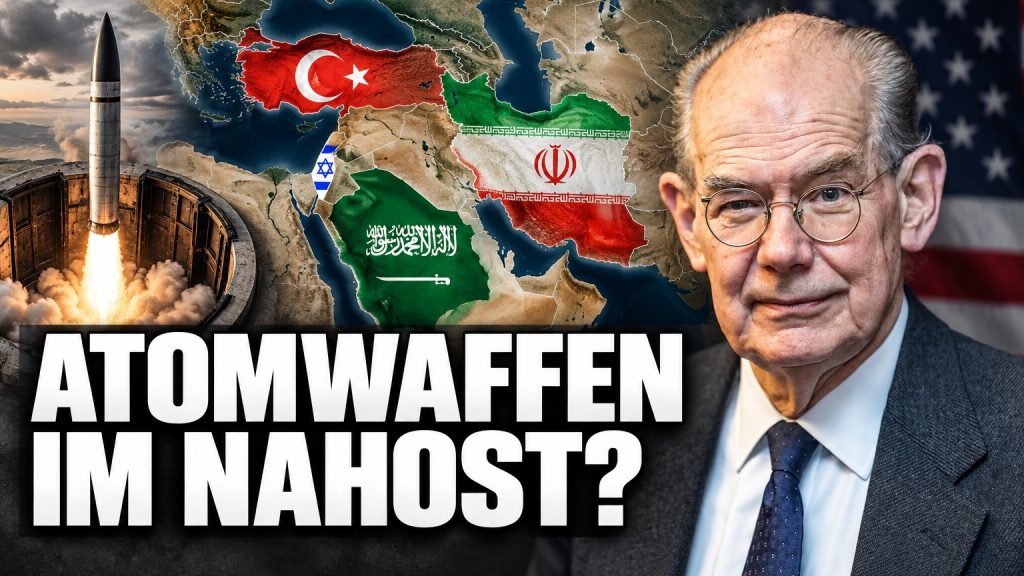
In this video, political scientist Prof. John Mearsheimer answers a channel member’s question about the future of nuclear proliferation in the Middle East. If Iran develops a nuclear deterrent, would Saudi Arabia, Turkey and other regional powers eventually follow — and could that produce greater stability, or make the region far more dangerous?
Mearsheimer examines why both Iran and Saudi Arabia may now have stronger incentives to consider nuclear deterrence, how the United States and Israel could respond, and why the most dangerous period may come before new nuclear powers achieve a secure deterrent. Could nuclear proliferation ultimately create stability — or could the path toward it trigger an even greater conflict?
This video was produced by John Mearsheimer and published on his YouTube channel on the 6th of November 2026. We have translated it into German and are republishing it today to help build opinion on this issue in Germany and beyond.
To read the transcript of the interview: The Danger of a Nuclear Middle East | Ask the Professor
We are transitioning away from YouTube. Be sure to subscribe to the following channels to stay updated with our journalism:
About our import program: In this program, we publish content from external authors, activists and journalists. This includes both international and local content that, in our editorial opinion, is not sufficiently covered in the media landscape. The content does not necessarily reflect acTVism Munich’s own editorial stance.
Click here or on the picture below:

John J. Mearsheimer is the R. Wendell Harrison Distinguished Service Professor of Political Science at the University of Chicago, where he has taught since 1982. He graduated from West Point in 1970 and then served five years as an officer in the U.S. Air Force. He then started graduate school in political science at Cornell University in 1975. He received his Ph.D. in 1980. He spent the 1979-1980 academic year as a research fellow at the Brookings Institution, and was a post-doctoral fellow at Harvard University’s Center for International Affairs from 1980 to 1982. During the 1998-1999 academic year, he was the Whitney H. Shepardson Fellow at the Council on Foreign Relations in New York.
Citation of featured image:



Leave a Reply